
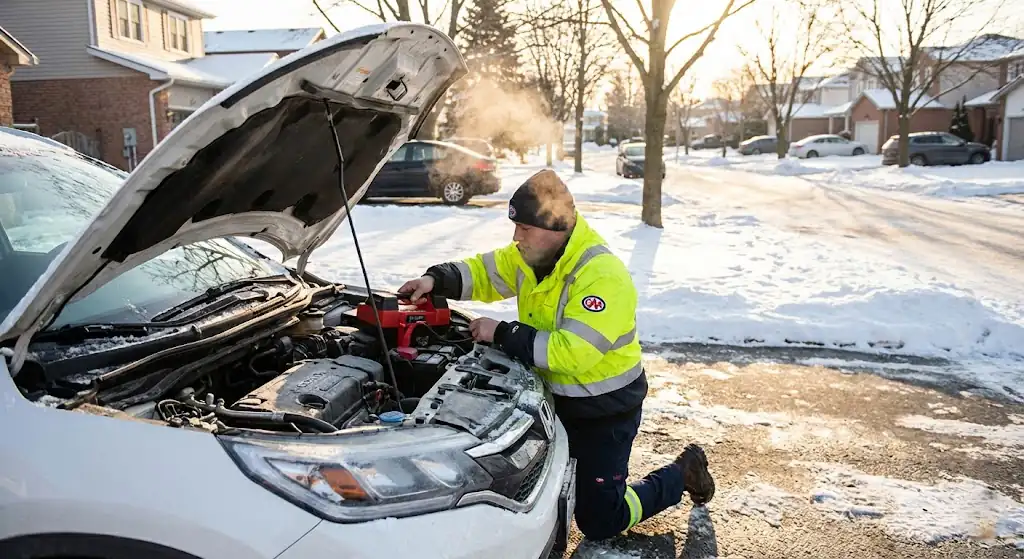
How To Jump Start a Car Safely: Step-by-Step Winnipeg Guide
⚡ Quick Answer
To jump start a car: connect the red (positive) cable to the dead battery’s positive terminal first, then to the good battery’s positive terminal. Connect the black (negative) cable to the good battery’s negative terminal, then to an unpainted metal surface on the dead car — never to the dead battery’s negative terminal. Start the working car, wait 2–3 minutes, then start the dead car.
Not comfortable doing it yourself? Call (204) 505-4621 for a professional battery boost — 24/7, anywhere in Winnipeg.
Knowing how to jump start a car is one of the most useful skills any Winnipeg driver can have. In a city where winter temperatures regularly drop below –30°C and dead batteries are the number one roadside breakdown, a proper car jump start can get you back on the road in minutes — or, done incorrectly, it can damage expensive electronics, cause a battery explosion, or injure you.
This guide walks you through the exact step-by-step process to safely boost a car battery using jumper cables or a portable jump starter, following Transport Canada’s vehicle safety standards. You will also learn what not to do, when jumping is not enough, and when to call a professional battery boost service instead.
What You Need To Jump Start a Car
Before you begin, make sure you have one of the following:
Jumper Cables + Second Vehicle
A set of jumper cables (at least 4-gauge, 20 feet long recommended) and a second vehicle with a working battery. This is the traditional method and the most common way Winnipeg drivers jump start a car.
Portable Jump Starter Pack
A battery-powered portable jump starter (lithium or lead-acid). These compact units do not require a second vehicle. Keep one charged in your trunk — essential winter gear in Winnipeg.
You should also have a pair of gloves (rubber or leather), safety glasses, and a flashlight if working in the dark. Never attempt a jump start near fuel leaks, sparks, or open flames.
How To Jump Start a Car With Jumper Cables (Step-by-Step)
Follow these steps in exact order. The connection sequence matters — getting it wrong can damage electronics or cause a spark near the battery.
Position Both Vehicles
Park the working vehicle close to the dead vehicle so the jumper cables can reach both batteries. The cars should be close but never touching. Turn off both engines, engage both parking brakes, and turn off all lights, heaters, and accessories in both vehicles.
Open Both Hoods and Locate the Batteries
Find the battery in each vehicle. Identify the positive terminal (marked with a + symbol, usually with a red cap or red wire) and the negative terminal (marked with a – symbol, usually with a black cap or black wire). If the terminals are corroded, brush off loose corrosion with a cloth before attaching cables.
🔴 Connect RED Cable — Dead Battery POSITIVE (+) First
Clamp one end of the red (positive) jumper cable to the positive (+) terminal of the dead battery. Make sure the clamp grips firmly and does not slide off. This is always the first connection you make.
🔴 Connect RED Cable — Good Battery POSITIVE (+)
Clamp the other end of the red (positive) cable to the positive (+) terminal of the good battery in the working vehicle.
⚫ Connect BLACK Cable — Good Battery NEGATIVE (–)
Clamp one end of the black (negative) jumper cable to the negative (–) terminal of the good battery.
⚫ Connect BLACK Cable — UNPAINTED METAL on Dead Car (NOT the Battery!)
This is the most important step. Clamp the other end of the black (negative) cable to an unpainted metal surface on the dead car’s engine block or frame — such as an engine bolt, a bracket, or the strut tower. Do NOT connect it to the dead battery’s negative terminal. This grounding technique prevents sparks near the battery where hydrogen gas may be present.
Start the Working Vehicle
Start the engine of the vehicle with the good battery. Let it idle for 2 to 3 minutes to allow charge to transfer into the dead battery. In extreme Winnipeg cold (below –25°C), let it idle for 5 minutes or more — cold-soaked batteries need more time to accept a charge.
Start the Dead Vehicle
Try to start the dead vehicle. If it cranks slowly but does not start, wait another 2 to 3 minutes and try again. If it does not start after three attempts (about 10 minutes total), the battery may be too far gone for a jump start — you likely need a professional battery boost or replacement.
Remove Cables in Reverse Order
Once the dead car is running, disconnect the cables in the exact reverse order: black cable from the grounding point on the dead car first, black cable from the good battery second, red cable from the good battery third, red cable from the previously-dead battery last. Do not let the clamps touch each other or any metal surface while disconnecting.
Drive for at Least 20 Minutes
After a successful jump start, drive the vehicle for at least 20 to 30 minutes without stopping. This allows the alternator to recharge the battery. Avoid turning the engine off for short stops — if the battery is weak, it may not restart without another boost.
Jump Start Cable Connection Order (Quick Reference)
Memorize this sequence. Getting the order right is the difference between a safe jump start and a dangerous mistake:
Disconnection order is the exact reverse: 4th off first, 3rd off second, 2nd off third, 1st off last.
How To Jump Start a Car With a Portable Jump Starter
Portable jump starters have become popular because they eliminate the need for a second vehicle. These compact lithium-ion units can start most cars and fit in your glove box. Here is how to use one:
Turn off your vehicle completely — keys out of the ignition, all accessories off.
Connect the red clamp to the dead battery’s positive (+) terminal.
Connect the black clamp to an unpainted metal ground point on the engine — same rule as with jumper cables.
Power on the jump starter unit and wait for the ready indicator (usually a green light).
Start the car. If it does not start on the first try, wait 30 seconds and try again. Do not exceed three attempts to avoid draining the portable unit.
Disconnect once the car is running — black clamp first, then red. Drive for at least 20 minutes to recharge the battery.
💡 Winnipeg Winter Tip
Lithium-ion portable jump starters lose effectiveness in extreme cold. If your unit has been sitting in your trunk in –30°C weather, bring it inside to warm up for 10 to 15 minutes before use. Some models have a pre-heat function — use it. Storing the unit inside your home and carrying it to the car when needed is the most reliable approach in Winnipeg winters.
5 Common Jump Start Mistakes That Can Damage Your Car
A bad jump start can cost more than a new battery. Avoid these common errors:
❌ Mistake 1: Connecting Black Cable to Dead Battery’s Negative Terminal
This creates a spark right next to the battery, which can ignite hydrogen gas venting from the battery. The result can be a battery explosion, spraying sulfuric acid. Always ground the black cable to unpainted engine metal instead.
❌ Mistake 2: Reversing Positive and Negative Cables
Connecting positive to negative (or vice versa) creates a short circuit that can destroy the alternator, fry the ECU (engine computer), blow fuses, and damage both vehicles’ electrical systems. This mistake can cost $500 to $2,000+ in repairs.
❌ Mistake 3: Letting Cable Clamps Touch Each Other
If the red and black clamps touch while connected to a battery, they create an instant short circuit with a shower of sparks. Keep the clamps separated at all times when one end is connected to a battery.
❌ Mistake 4: Attempting To Jump a Frozen Battery
In Winnipeg’s extreme cold, a fully discharged battery can freeze solid. If you see bulging sides, ice crystals on the terminals, or the battery case looks swollen, do not attempt a jump start — a frozen battery can explode. Call for professional help instead.
❌ Mistake 5: Immediately Turning Off the Engine After Jump Starting
If you turn off the engine right after a jump start, the battery has not recharged. It will likely be dead again when you try to restart. Drive for at least 20 minutes (highway driving is best) to give the alternator time to recharge the battery.
Not Comfortable Doing It Yourself?
Our operators carry professional boosting equipment and handle it safely in any weather.
When a Jump Start Is Not Enough
A jump start is a temporary fix — it gets your engine running, but it does not fix the reason the battery died. If any of these situations apply, the battery (or another component) needs attention beyond a simple jump:
- Battery is more than 3–4 years old — Car batteries in Winnipeg typically last 3 to 4 years due to extreme temperature swings. If your battery is in that range and dies, it probably needs replacement rather than repeated boosting.
- Battery dies again within 24 hours — If the battery will not hold a charge after driving for 30+ minutes, the battery has likely reached end of life or there is a parasitic drain in the electrical system.
- Vehicle does not start even with a jump — If the engine cranks but will not fire, or if nothing happens at all even with cables connected, the problem may be the starter motor, alternator, ignition switch, or another component — not just the battery. You may need a breakdown tow to a mechanic.
- Battery terminals are severely corroded — Heavy corrosion can prevent a good connection even with jumper cables. Terminal cleaning or replacement may be needed before a boost will work.
- Battery case is cracked, leaking, or swollen — Physical damage to the battery means it must be replaced immediately. Do not jump start a damaged battery under any circumstances.
Why Car Batteries Die So Often in Winnipeg
Winnipeg is one of the hardest cities on car batteries in North America. Understanding why helps you prevent the next dead battery and avoid needing a car jump start on the coldest morning of the year.
Extreme cold reduces battery capacity. A fully charged battery delivers 100% of its cranking power at 26°C. At –18°C, it drops to about 65%. At –29°C (a regular Winnipeg January night), it drops below 50%. Meanwhile, a cold engine needs up to twice the cranking power to start. So you have half the power trying to do double the work.
Short trips in winter drain the battery. If you drive less than 15 to 20 minutes per trip, the alternator does not fully recharge the battery — especially when the heater, seat heaters, defroster, and headlights are all pulling power. After several short winter trips, the battery’s charge level drops until it cannot start the car.
Age accelerates failure. Extreme temperature swings between Winnipeg summers (35°C) and winters (–35°C) stress the battery’s internal chemistry faster than moderate climates. Batteries that last 5 to 6 years in Vancouver often last only 3 to 4 in Winnipeg. For a deeper look at cold-weather battery failure, read our guide on why car batteries die in winter. And remember, a dead battery is not the only winter roadside problem — keep our number handy for flat tire changes and winching too.
How Much Does a Battery Boost Cost in Winnipeg?
If you cannot jump start your car yourself, here is what professional help costs in Winnipeg:
For more information on towing and roadside service pricing in Winnipeg, check our detailed cost breakdown. Winnipeg Towing provides 24-hour towing and roadside battery boost service with upfront pricing and no hidden fees.
How To Prevent a Dead Battery in Winnipeg
Taking a few simple steps can keep you from needing a car jump start on the coldest morning of the year:
🔌 Use a Block Heater
Plug in your block heater when temps drop below –15°C. This keeps the engine warm, reducing the cranking power needed to start and easing the load on your battery.
🔋 Test Your Battery Before Winter
Get a free battery test at most auto parts stores in September or October. If your battery tests “marginal” or is over 3 years old, replace it before the first cold snap — otherwise you risk needing a 24-hour emergency boost on the coldest night of the year.
🧹 Clean the Terminals
Corrosion on battery terminals increases resistance and reduces charging efficiency. Clean terminals with a wire brush and apply dielectric grease once a year.
🚗 Take Longer Drives
If you only drive short trips in winter, take a 20 to 30 minute highway drive once a week to let the alternator fully recharge your battery. Short trips are the silent battery killer in Winnipeg.
🧰 Keep a Portable Jump Starter
A quality lithium-ion portable jump starter costs $80 to $150 and can save you from being stranded. Keep it charged and bring it from indoors when heading to the car in extreme cold.
⚡ Check for Parasitic Drains
Aftermarket accessories, dashcams running 24/7, or faulty modules can slowly drain your battery overnight. If your battery dies repeatedly despite being new, have a mechanic test for parasitic draw. If the car will not start at all, you may need a flatbed tow to a shop for electrical diagnosis.
Can You Jump Start a Hybrid or Electric Vehicle?
This is an important distinction that many Winnipeg drivers get wrong:
Hybrid vehicles (Toyota RAV4 Hybrid, Ford Escape Hybrid, etc.) — Most hybrids have a small 12-volt battery that powers accessories and starts the system. This 12V battery can die and can be jump started using the same procedure described above. However, never use a hybrid as the donor vehicle to jump start another car — the electrical system is not designed for it and can be damaged.
Fully electric vehicles (Tesla, Chevy Bolt, etc.) — EVs also have a small 12V battery for accessories. It can be jump started, but the process varies by manufacturer. Check your owner’s manual. Never attempt to jump start the main high-voltage battery pack — it operates at 400V+ and attempting to boost it with jumper cables is extremely dangerous.
⚠️ Safety Warning
If you are unsure whether your vehicle is safe to jump start — especially hybrids, EVs, or vehicles with damaged batteries — call (204) 505-4621 and let a professional handle it. A wrong connection on a hybrid or EV can cause thousands of dollars in electrical damage. Our operators are trained to handle all vehicle types including hybrids and electric vehicles safely. We serve all Winnipeg neighbourhoods.
Winter Emergency Kit: What Every Winnipeg Driver Should Carry
Beyond jumper cables, every Winnipeg vehicle should carry a winter emergency kit. If you are stranded waiting for a boost or a roadside assistance call, this kit keeps you safe:
- Jumper cables (4-gauge, 20 feet) or portable jump starter
- Warm blanket, extra gloves, and a toque
- Flashlight with extra batteries (or a hand-crank flashlight)
- Phone charger (12V car adapter and/or portable power bank)
- Small shovel and bag of kitty litter or sand (for traction on ice)
- Granola bars and bottled water
- Reflective warning triangles or emergency visibility gear
Frequently Asked Questions About Jump Starting a Car
Which cable goes on first when jump starting a car?
The red (positive) cable always goes on first, connecting to the dead battery’s positive terminal. The last connection is the black (negative) cable, which attaches to an unpainted metal surface on the dead car’s engine, not to the battery itself.
How long should I let a car run after a jump start?
Drive the vehicle for at least 20 to 30 minutes after a successful jump start to allow the alternator to recharge the battery. Highway driving at higher RPMs charges the battery faster than idling. Avoid turning the engine off for short stops during this recharging period.
Can jump starting damage my car?
Yes, if done incorrectly. Reversing the cables can destroy the alternator, ECU, and other electronics. Connecting the ground cable directly to the dead battery’s negative terminal instead of an engine ground creates spark and explosion risk. Attempting to jump a frozen or physically damaged battery is also dangerous. Follow the correct procedure and you will be fine.
How much does a professional battery boost cost in Winnipeg?
A professional mobile battery boost in Winnipeg typically costs $55 to $100. The operator comes to your location 24/7 with professional boosting equipment. Winnipeg Towing provides upfront pricing on the phone before dispatching.
Why does my battery keep dying after I jump start it?
If the battery dies again within a few hours or days after a jump start, the battery itself is likely failing and needs replacement. Other causes include a faulty alternator that is not recharging the battery, a parasitic electrical drain from an accessory or module, or corroded terminal connections reducing charge flow.
Can I jump start a car in the rain or snow?
Yes. Jump starting in rain or snow is safe as long as the battery terminals are accessible and you keep cable clamps from touching each other. Water on the battery surface does not create a short circuit at 12 volts. However, in Winnipeg blizzard conditions where visibility is near zero or you are on a busy road, it may be safer to call for professional help.
What size jumper cables do I need for a Winnipeg winter?
Use 4-gauge or lower (2-gauge is even better) jumper cables, at least 20 feet long. Thin 8 or 10-gauge cables may not carry enough current to start a cold-soaked engine in extreme Winnipeg temperatures. Invest in heavy-duty cables — they last for years and make a real difference at minus 30.
How long does a car battery last in Winnipeg?
In Winnipeg’s extreme climate, a car battery typically lasts 3 to 4 years. In milder climates, the same battery might last 5 to 6 years. Extreme cold in winter and heat in summer accelerate chemical degradation inside the battery. Get your battery tested before each winter season.
Should I jump start my car or call a tow truck?
If you have jumper cables and a willing second vehicle (or a portable jump starter), and you are comfortable with the procedure, try a jump start first. If you are in an unsafe location, the battery looks damaged or frozen, you have tried jumping and it did not work, or you are simply not confident doing it — call (204) 505-4621 for a professional battery boost or emergency towing.
How do I know if my car battery is frozen?
A frozen battery may show bulging or swollen sides, visible ice or frost forming around the terminals, or a cracked case. If the battery feels unusually heavy for its size or you hear liquid sloshing that sounds thick, the electrolyte may be partially frozen. Never attempt to jump start a frozen battery — it can explode. Call a professional for safe removal and replacement.
Dead Battery? We’ll Boost You Fast.
Professional battery boost service — 24/7, anywhere in Winnipeg, no hidden fees.
Call and we will be there in 20 to 40 minutes.