What To Do If You Hit a Pothole in Winnipeg & Your Tire Blows Out
🕳️ Quick Answer
If you hit a pothole and your tire blew out: 1) Do NOT slam the brakes — ease off the gas and steer straight. 2) Pull over to the nearest safe spot. 3) Do not drive on the flat tire — every metre destroys the rim. 4) Change to your spare if you have one, or call for help. 5) Document the pothole for a damage claim. A pothole blowout often damages both the tire AND the rim — meaning tire repair is not possible and full replacement is needed.
Need help now? Call (204) 505-4621 — flat tire change or tow, 24/7 in Winnipeg.
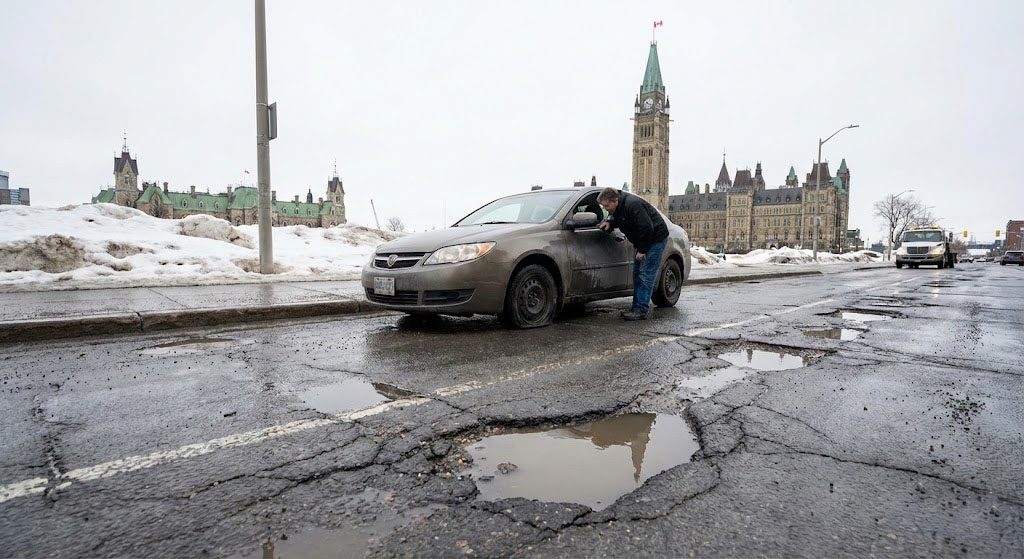
BANG. The steering wheel jerks. The car drops on one corner. That sickening flapping sound starts immediately. You just hit a pothole — one of Winnipeg’s thousands — and your tire is destroyed.
Pothole damage is the single most common cause of flat tire calls in Winnipeg, especially from March through June when the freeze-thaw cycle tears the road surface apart. Unlike a slow nail puncture that leaks over hours, a pothole blowout is instant and violent — the tire sidewall ruptures on impact, the rim slams into the broken pavement edge, and the damage is immediate and severe.
This guide covers exactly what to do in the first 60 seconds after hitting a pothole, how to assess the damage, whether tire repair is possible or you need replacement, how much it costs, how to file a damage claim with the City of Winnipeg, and when you need towing versus a roadside tire change. For broader pothole prevention, see our spring thaw potholes guide.
The First 60 Seconds After Hitting a Pothole
What you do immediately after the impact determines whether this is a $150 problem or a $1,000+ problem:
Do NOT Slam the Brakes
Your instinct is to brake hard. Resist it. With a blown tire, hard braking causes the vehicle to pull violently toward the flat side, potentially sending you into oncoming traffic or off the road. Instead, ease off the accelerator gradually and grip the steering wheel firmly to keep the vehicle straight.
Turn On Hazard Lights Immediately
Alert other drivers that something is wrong. A vehicle suddenly slowing down or weaving is unpredictable to everyone behind you. Hazards buy you a safety margin while you find a place to stop.
Pull Over to the Nearest Safe Spot — But Do Not Drive Far
A parking lot, side street, or wide shoulder within 50 to 100 metres is ideal. Do NOT drive kilometres to “a better spot.” As our flat tire guide explains, every 100 metres on a flat tire grinds the rim and destroys the tire beyond repair. The rim itself — $150 to $500+ — starts getting destroyed within the first 100 metres.
Check All Four Tires and the Undercarriage
A severe pothole hit can damage more than one tire. Walk around the vehicle and check all four tires for visible damage — bulges, cuts, flat spots, or complete blowouts. Look underneath for anything hanging or dragging. Check the rims for dents, cracks, or bends. If you see fluid dripping (oil, coolant, transmission fluid), the impact may have damaged the undercarriage.
Decide: Change the Tire or Call for Help
If you have a spare tire, jack, and lug wrench — and you are in a safe, flat, well-lit location — you can change it yourself. See our flat tire guide. If you have no spare, are on a busy road, or are unsure of the procedure, call (204) 505-4621 for flat tire service ($75–$150) or a flatbed tow ($85–$175). See our emergency flat tire service guide for when professional help is the smarter choice.
Pothole Damage Assessment: What To Check Beyond the Tire
A pothole blowout rarely damages only the tire. The impact transmits force through the entire wheel assembly. Here is everything that can be damaged and how to check:
If you observe any damage beyond the tire itself — bent rim, pulling, clunking, fluid leaks — do NOT drive. Call for a breakdown tow at (204) 505-4621. A tow at $85 to $175 prevents turning a $500 repair into a $2,000+ chain of failures. For a full decision framework, see our tow-or-drive decision guide.
Pothole Flat Tire: Repair or Replacement?
Pothole damage is fundamentally different from a nail puncture. Here is how to know which you need:
✅ Repair Possible ($25–$45)
• Damage is ONLY a small puncture in the tread area
• Tire sidewall is intact (no bulges, cuts, or deformation)
• Rim is not bent or cracked
• You stopped immediately and did not drive on the flat
This scenario is rare with pothole hits — most pothole damage affects the sidewall.
❌ Replacement Required ($120–$250+)
• Sidewall is bulging, cut, or ruptured
• Tire has internal cord damage (visible through the rubber)
• Tire was driven flat for more than 100 metres
• Rim is bent and the tire no longer seals properly
This is the typical outcome of a pothole blowout in Winnipeg.
For a complete guide to making this decision, see our detailed tire repair vs replacement guide. If you need to match a new tire to your existing set, a tire shop can advise on brand and size compatibility.
Pothole Blowout? We Handle It — Roadside or Tow.
Tire change to your spare ($75–$150) or flatbed tow to a tire shop ($85–$175). 20–40 min average arrival.
How To File a Pothole Damage Claim in Winnipeg
If a pothole on a Winnipeg city road caused your flat tire or vehicle damage, you may be able to recover repair costs. According to the City of Winnipeg, here is how the process works:
Document everything at the scene. Photograph the pothole (show its size and depth), its location (include a street sign or landmark), all vehicle damage (tire, rim, undercarriage), and the surrounding road conditions. Note the exact date, time, and address. This evidence is essential.
Report the pothole to the city. Call 311 or use the City of Winnipeg’s online reporting tool. This creates an official record that the hazard exists. If the city already knew about the pothole and had not repaired it within a reasonable time, your claim is stronger.
Get repair estimates. Take the vehicle to a tire shop and get a written estimate for the tire, rim, alignment, and any other damage. Keep the damaged tire and rim if possible — the city may want to inspect them.
File a claim with the City of Winnipeg’s Risk Management. Submit your photos, repair estimate, pothole report number, and a description of the incident. The city will investigate whether the pothole was known, how long it had existed, and whether they had a reasonable opportunity to repair it before your incident.
Consider MPI as an alternative. If the city denies the claim (common), you can file through your MPI Autopac policy. Pothole damage falls under collision coverage, so your deductible applies ($500 standard). If the total damage exceeds the deductible, this may be worthwhile. See our insurance towing page for MPI reimbursement details.
💡 City Claim Success Tips
Claims succeed more often when: the pothole was on a major road (city responsibility, not provincial), the pothole had been previously reported (check 311 records), you have dashcam footage, there were witnesses, and you filed within 30 days. Claims are denied more often when: the road is a provincial highway (file with Manitoba Infrastructure instead), the driver was speeding, or the pothole appeared between the last inspection and your incident.
Why Winnipeg Has the Worst Potholes in Canada
Winnipeg’s pothole problem is not poor maintenance — it is physics. According to CAA’s annual worst roads survey, Manitoba consistently ranks among the worst provinces for road conditions. Here is why:
- Extreme freeze-thaw cycles — Winnipeg experiences more freeze-thaw cycles per year than almost any other major Canadian city. Water seeps into road cracks, freezes and expands, then thaws and leaves voids. Each cycle makes the hole bigger.
- Clay soil base — Winnipeg’s gumbo clay soil expands when wet and contracts when dry, shifting the road base underneath the pavement and creating subsurface voids that collapse into potholes.
- Heavy vehicle traffic — buses, trucks, and commercial vehicles concentrate weight on already-weakened road surfaces, accelerating pothole formation on routes like Portage Avenue, Pembina Highway, and Main Street. See our worst roads for breakdowns guide.
- Spring timing — the worst potholes appear from March through May, exactly when road crews are still dealing with snow clearing and the frost has not fully left the ground. Permanent repairs often cannot begin until June. See our spring thaw pothole guide for seasonal details.
- Construction zones compound the problem — road construction exposes fresh surfaces that are vulnerable to immediate pothole formation. See our construction zone driving guide.
How To Minimize Pothole Damage to Your Vehicle
You cannot avoid every pothole in Winnipeg, but you can reduce the severity of the damage:
🛞 Maintain Proper Tire Pressure
Properly inflated tires absorb impact better than under-inflated ones. An under-inflated tire has less cushion between the rim and the road — a pothole hit is more likely to cause a blowout and rim damage. Check monthly, weekly during pothole season. See our tire pressure guide.
👀 Scan the Road Ahead
Most pothole hits happen because drivers are looking at the car ahead rather than the road surface. Scan 10 to 15 seconds ahead for surface irregularities. Puddles often hide potholes — treat any standing water on a Winnipeg road as a potential crater.
🐢 Slow Down on Damaged Roads
Impact force increases exponentially with speed. A pothole hit at 30 km/h is survivable for most tires. The same pothole at 60 km/h can destroy the tire, rim, and suspension in one hit. During pothole season, treat rough roads as reduced-speed zones.
💪 Replace Worn Tires Promptly
Tires with adequate tread depth have more rubber between the road hazard and the tire’s internal structure. Thin tread offers almost no protection against pothole impacts. Replace tires at 4/32 of an inch, not just the legal minimum of 2/32. See our tire repair vs replacement guide.
🛡️ Consider Road Hazard Warranty
Many Winnipeg tire retailers offer road hazard warranties ($10–$30 per tire) that cover pothole damage, nail punctures, and impact damage. In Winnipeg, this add-on pays for itself faster than almost anywhere else in Canada.
📞 Save a Towing Number
When a pothole takes out your tire, having (204) 505-4621 saved means one-tap help instead of a panicked search. We provide 24-hour service across all Winnipeg neighbourhoods. See our response time guide for arrival expectations.
Frequently Asked Questions
Can a pothole-damaged tire be repaired?
Rarely. Pothole damage typically affects the tire sidewall — the weakest structural part — which cannot be safely repaired. A plug-patch tire repair ($25–$45) only works for punctures in the tread area with no sidewall involvement. If the sidewall has a bulge, cut, or internal cord damage, replacement ($120–$250+) is required. See our repair vs replacement guide.
How much does pothole tire damage cost to fix?
Tire replacement: $120–$250+. Rim repair or replacement: $150–$500+. Alignment: $80–$120. Suspension repair (if needed): $300–$800+. A typical pothole blowout with rim damage totals $300 to $750. Add suspension damage and the total can reach $1,500+. Our roadside tire change costs $75–$150 and our towing cost guide covers transport pricing.
Can I claim pothole damage from the City of Winnipeg?
Yes — file a claim with the City of Winnipeg’s Risk Management department. Document the pothole, damage, location, and date thoroughly. Success rates vary. The city is more likely to pay if the pothole was previously reported and not repaired. For provincial highways, file with Manitoba Infrastructure instead. See the detailed filing process above.
Does MPI cover pothole damage?
Yes — pothole damage falls under your Autopac collision coverage. Your deductible ($500 standard) applies. If total damage exceeds the deductible, filing an MPI claim is worthwhile. If the damage is under $500 (a single tire only), it may not be worth claiming. Extension coverage may provide a lower deductible.
I hit a pothole and now my car pulls to one side. Is it safe to drive?
A slight pull after a pothole hit usually means the alignment has shifted — driveable to a mechanic at low speed, but get it checked soon. A hard pull that you struggle to correct means possible suspension or steering component damage — do NOT drive. Call for a tow. See our tow-or-drive guide for more symptoms.
What is the worst time of year for potholes in Winnipeg?
March through May is the worst period. The freeze-thaw cycle is most active, snow-melt water fills cracks, and the road surface breaks apart daily. By June, city crews begin permanent repairs. But pothole season extends into summer through construction zones where new surfaces create new potholes.
Can a pothole damage my rim even if the tire didn’t blow out?
Yes. A hard pothole hit can bend or crack a rim without blowing the tire. The rim may develop a slow air leak where the bent edge no longer seals against the tire bead. Symptoms include the TPMS light coming on repeatedly and the tire losing pressure over days. Have a tire shop inspect the rim if you hit a severe pothole even if the tire seems fine.
How fast can a tow truck get to me after a pothole blowout?
Average response across Winnipeg is 20 to 40 minutes. During spring pothole season (March–May), demand is higher but we maintain response targets. Call (204) 505-4621 for an immediate ETA. See our tow truck response time guide.
Should I report the pothole even if I don’t file a damage claim?
Yes — call 311 or use the City of Winnipeg’s online tool. Reporting creates a record that helps future drivers file claims and puts the pothole on the city’s repair priority list. It also protects other vehicles from hitting the same hazard. If you share the road, report the hazard. For broader Winnipeg road safety, see our complete roadside assistance guide.
Does a dashcam help with pothole damage claims?
Significantly. A dashcam recording showing the pothole, the road conditions, and the moment of impact is the strongest evidence you can provide for a city or MPI claim. It eliminates disputes about the pothole’s size, location, and your driving behaviour at the time. If you drive in Winnipeg regularly, a dashcam ($50–$150) can pay for itself with a single successful pothole claim. For all our emergency kit recommendations, including dashcams, see our winter kit guide.
Pothole Got You? One Call Fixes It.
Tire change · Flatbed tow · Any neighbourhood · Upfront pricing · 24/7.
24/7 service across all Winnipeg neighbourhoods.