Car Overheating in Winnipeg Summer: What To Do & When To Call a Tow
🌡️ Quick Answer
If your car is overheating: pull over immediately, turn off the engine, and do NOT open the radiator cap. Wait at least 30 minutes for the engine to cool. If the temperature gauge goes back to normal and coolant levels are okay, you may be able to drive to a mechanic. If the car overheats again or steam/smoke continues, call for a tow — driving an overheating engine risks catastrophic damage costing $3,000 to $8,000+.
🚛 Need a tow right now? Call (204) 505-4621 — 24/7, anywhere in Winnipeg.
Winnipeg drivers are well-prepared for winter breakdowns — dead batteries, icy roads, and frozen fuel lines dominate the conversation from November through March. But Winnipeg’s summers are no joke either. When temperatures climb to 30°C, 35°C, or higher and you are sitting in stop-and-go traffic on Portage Avenue with the AC blasting, your engine’s cooling system is working harder than at almost any other time of year.
A car overheating in summer is one of the most common and most expensive roadside emergencies in Winnipeg. Unlike a dead battery (which costs $55 to $100 to boost) or a flat tire (which costs $75 to $150 to fix roadside), an overheated engine that is driven too far can result in a blown head gasket, warped cylinder head, or seized engine — repairs that cost $3,000 to $8,000 or more, often totalling the vehicle.
This guide explains exactly what to do when your car overheats, what causes engine overheating in summer, how to tell if it is safe to drive or if you need a tow truck, and how to prevent it from happening in the first place.
What To Do Immediately When Your Car Overheats
The first five minutes after your temperature gauge spikes are critical. What you do (and what you avoid doing) determines whether this is a $100 coolant top-up or a $5,000+ engine rebuild. Follow these steps in order:
Turn Off the AC and Turn On the Heater
This sounds counterintuitive on a hot day, but the heater core acts as a secondary radiator — it pulls heat away from the engine and blows it into the cabin. Set the heater to maximum heat, maximum fan speed, and open the windows. This buys your engine valuable cooling time, sometimes enough to get you to safety.
Pull Over Safely and Turn Off the Engine
If the temperature gauge continues to climb toward the red zone or the engine warning light comes on, pull over to a safe location immediately — a parking lot, side street, or wide shoulder. Turn off the engine completely. An idling engine still generates heat. Shutting it down stops heat production and allows the cooling system to begin dissipating what is already there.
DO NOT Open the Radiator Cap or Coolant Reservoir
This is the most important safety warning. A hot cooling system is under extreme pressure. Opening the radiator cap or coolant reservoir on an overheated engine can release a geyser of boiling coolant that causes severe burns to your face, hands, and arms. Wait at least 30 minutes for the engine to cool before touching anything under the hood.
Pop the Hood (Carefully) To Let Heat Escape
Once the engine is off, use the interior hood release to pop the hood latch — but do not fully open the hood yet if steam is actively venting. Let the initial steam dissipate. After a few minutes, open the hood fully to allow heat to escape faster. Use a cloth or glove to lift the hood if the latch is hot.
Wait 30 Minutes, Then Assess
After 30 minutes of cooling, check the temperature gauge. If the engine has cooled to normal operating temperature, carefully (with a cloth) open the coolant reservoir and check the level. If coolant is low, topping it up with water or a 50/50 coolant mix may get you to a mechanic. If the reservoir is empty, the coolant has leaked out and driving is risky.
Decide: Drive to a Mechanic or Call for a Tow
If the temperature gauge returns to normal after cooling and you can top up coolant, you may be able to drive cautiously to a nearby mechanic — keep the heater on and monitor the gauge constantly. If the gauge climbs again at any point, pull over immediately and call (204) 505-4621 for a breakdown tow. A tow truck costs $85 to $175 — an engine replacement costs $3,000 to $8,000+.
When a Car Overheating Requires a Tow Truck
Not every overheating incident needs a tow. But in these situations, driving is too risky and a tow truck is the smart call:
🚨 Temperature Gauge Stays in the Red
If the gauge will not come down after 30+ minutes of cooling, the cooling system has a serious failure. Driving will cause further overheating and engine damage.
🚨 Steam or Smoke From Under the Hood
Continuous steam means coolant is actively leaking onto hot engine components. Smoke (especially sweet-smelling white smoke) indicates coolant burning off. Either way, the system cannot cool the engine.
🚨 Coolant Is Leaking Visibly
If you see a pool of green, orange, or pink fluid under the vehicle, the cooling system has a leak. Driving without coolant will overheat the engine again within minutes, even with the heater on full blast.
🚨 The Engine Overheats Again After Restarting
If you restart the car and the gauge climbs back toward red within 5 to 10 minutes, the underlying problem has not been resolved. Pull over immediately and call for a tow. Do not push it.
🚨 Engine Warning Light Is Flashing
A flashing (not steady) engine warning light typically means a severe problem that risks immediate damage. Combined with an overheating gauge, this is a clear signal to stop driving and call for a flatbed tow.
🚨 Strange Noises From the Engine
Knocking, ticking, or grinding noises from an overheated engine suggest internal damage may have already begun — warped metal, seized bearings, or a failing water pump. Continuing to drive risks turning a repairable problem into a total engine failure.
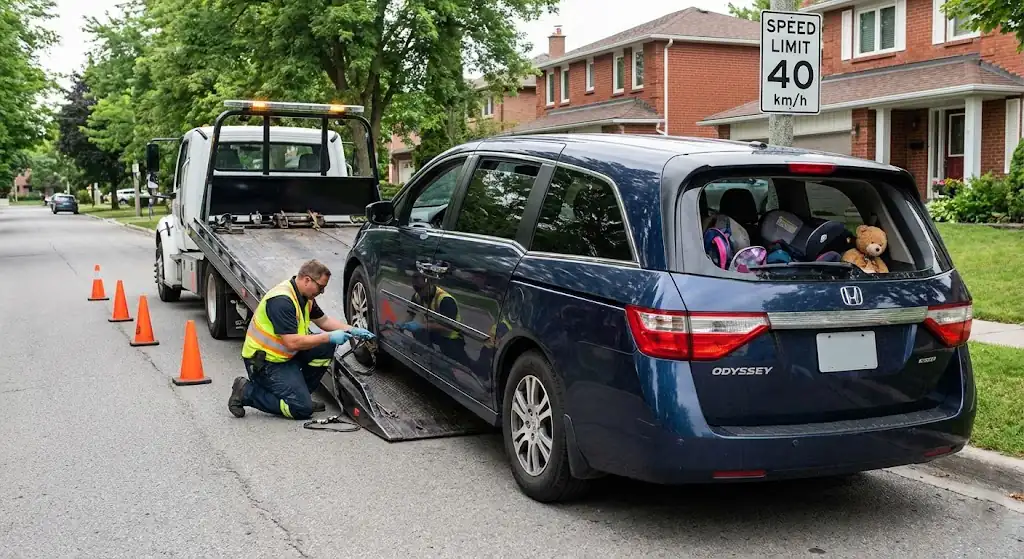
Call (204) 505-4621 and we will send a flatbed tow truck to transport your vehicle safely to your mechanic or dealership. Flatbed towing is the only safe option for an overheated vehicle — wheel-lift towing can further stress a hot drivetrain. For more on towing types, see our guide on towing AWD and 4WD vehicles.
Engine Overheating? Don’t Drive It. Tow It.
A $85–$175 tow protects a $3,000–$8,000 engine. We flatbed your car to the shop safely.
Common Causes of Engine Overheating in Winnipeg Summers
Understanding why your car is overheating helps you explain the problem to your mechanic and may help you prevent it next time:
💡 Winnipeg-Specific Factor: Summer + Winter Damage
Winnipeg’s extreme winter cold causes hoses to become brittle and coolant connections to weaken. These weakened components often hold up through the cold months but fail when summer heat adds thermal stress. Many coolant leaks and hose failures in Winnipeg happen in June and July — months after the winter damage occurred. This is why a spring cooling system inspection is critical.
The Cost of Driving an Overheating Car (Why Towing Is Cheaper)
Here is the math that every driver should understand before deciding to “push through” an overheating engine:
✅ Stop and Tow
Tow to mechanic: $85 – $175
Repair (thermostat, hose, etc.): $100 – $800
Total: $185 – $975
❌ Keep Driving
Blown head gasket: $1,500 – $3,000
Warped cylinder head: $2,000 – $4,000
Seized engine (replacement): $4,000 – $8,000+
Or: Vehicle totalled
A tow truck at $85 to $175 is the cheapest insurance policy you will ever buy. See our guide on how much towing costs in Winnipeg or our affordable towing guide for tips on keeping that cost down.
Why Winnipeg Summers Are Harder on Engines Than You Think
According to Natural Resources Canada, vehicle cooling systems work hardest during high-temperature conditions combined with heavy engine loads. Winnipeg’s summers create the perfect storm for engine overheating:
- Extreme heat spikes — Winnipeg routinely hits 30°C to 35°C+ in July and August, with humidex values reaching 40°C+. Ambient air temperature directly affects the radiator’s ability to shed heat.
- Stop-and-go traffic — Idling and low-speed driving on Portage Avenue, Main Street, and the Perimeter Highway during rush hour minimizes airflow across the radiator, forcing the cooling fan to do all the work.
- Air conditioning load — Running the AC adds significant heat to the engine bay through the condenser. In heavy traffic with the AC running, cooling system capacity can be overwhelmed.
- Towing trailers and hauling — Pulling a boat, camper, or loaded trailer to the lake on a hot day pushes the engine to maximum load, generating far more heat than normal driving.
- Winter-weakened components — Hoses, clamps, and seals stressed by five months of extreme cold may fail under summer heat. Winnipeg vehicles endure a 70°C temperature swing between winter lows and summer highs, which accelerates material fatigue. CAA’s road condition reports confirm that Manitoba’s extreme climate is among the hardest on vehicles in Canada.
How To Prevent Your Car From Overheating This Summer
Most car overheating incidents are preventable with basic maintenance:
🧊 Check Coolant Level Monthly
When the engine is cold, check the coolant reservoir. The level should be between the “low” and “full” marks. If you are topping up frequently, you have a leak — get it inspected before summer heat arrives.
🔧 Get a Spring Cooling System Inspection
Ask your mechanic to inspect hoses, clamps, the radiator, water pump, thermostat, and belts in April or May — before the first hot spell. This $50 to $100 inspection catches problems when they are cheap to fix.
♻️ Replace Coolant on Schedule
Most vehicles need coolant replacement every 50,000 to 100,000 km or every 3 to 5 years. Old coolant loses its anti-corrosion and heat-transfer properties. Check your owner’s manual for the recommended interval.
👀 Watch the Temperature Gauge
Make a habit of glancing at the temperature gauge regularly, especially in traffic on hot days. The earlier you notice the gauge climbing, the sooner you can act — and the less likely you are to suffer expensive engine damage.
🧰 Keep Emergency Coolant in the Trunk
A jug of 50/50 pre-mixed coolant (or even a bottle of water in an emergency) can buy you enough cooling capacity to reach a mechanic after a minor leak. Add it to your summer car emergency kit.
🚛 Save (204) 505-4621
Have a towing number saved before you need it. When you are standing on a 35°C highway shoulder with steam pouring from under the hood, you do not want to be searching Google for a tow truck. We provide 24-hour service across all Winnipeg neighbourhoods.
Other Common Summer Breakdowns in Winnipeg
Engine overheating is not the only summer road hazard. Here are other warm-weather breakdowns Winnipeg Towing handles regularly:
- Flat tires from potholes and construction — Summer construction season exposes fresh road debris, and spring potholes are still being patched. See our flat tire guide and emergency flat tire service guide.
- Dead batteries from heat — Extreme heat accelerates battery degradation just like extreme cold. A battery weakened by winter may fail completely in summer. See our guide on battery boost vs replacement.
- Transmission overheating — Especially common in vehicles towing trailers. Transmission fluid overheats when hauling heavy loads in traffic. If the transmission temperature warning appears, pull over and call for a tow truck — breakdown towing to a shop prevents a $2,000+ transmission rebuild.
- Running out of gas on long drives — Summer road trips and unfamiliarity with rural gas station spacing leads to more fuel delivery calls. Rural Manitoba can have 50+ km gaps between stations.
- AC compressor failure — Not a safety emergency, but a comfort one. If the AC fails on a 35°C day, driving is unpleasant and potentially dangerous for passengers with health conditions. A tow to a mechanic may be the best option.
For the full spectrum of services, see our complete roadside assistance guide.
Frequently Asked Questions About Car Overheating
Can I drive my car if it is overheating?
Only if the temperature gauge returns to normal after cooling down and you have sufficient coolant. Even then, drive only a short distance to the nearest mechanic with the heater on full and the AC off. If the gauge rises again, stop immediately and call for a tow. Continuing to drive an overheating car risks catastrophic and expensive engine damage.
How much does it cost to fix an overheating car?
It depends on the cause. A simple coolant top-up or hose replacement costs $50 to $300. A thermostat replacement costs $150 to $350. A water pump replacement costs $350 to $800. A blown head gasket costs $1,500 to $3,000. The earlier you stop driving when the engine overheats, the cheaper the fix will be.
Why does my car only overheat in traffic?
At highway speed, air flows naturally across the radiator, cooling it efficiently. In slow traffic or at idle, the radiator cooling fan must do all the work. If the fan is weak, failing, or broken, the engine overheats only in low-speed conditions. This is the most common engine overheating summer pattern in Winnipeg’s congested areas.
Can I add water instead of coolant in an emergency?
Yes — in an emergency, plain water is better than running with an empty cooling system. Water will absorb heat and protect the engine temporarily. However, water alone does not have the anti-corrosion and anti-freeze properties of proper coolant, so get to a mechanic promptly to drain and refill with the correct 50/50 coolant mix.
How long should I wait before opening the radiator cap?
Wait at least 30 minutes after turning off the engine. The cooling system remains under pressure while hot, and opening the cap prematurely can release scalding coolant. When you do open it, use a thick cloth, turn it slowly to the first notch to release residual pressure, then fully remove once pressure has vented.
How much does a tow cost for an overheating car in Winnipeg?
A standard within-city tow for an overheating vehicle costs $85 to $175. We always use flatbed towing for overheated vehicles to avoid putting any additional stress on the drivetrain. The price is quoted upfront on the phone — same rate 24/7.
Does MPI cover towing for engine overheating?
MPI’s basic Autopac does not typically cover towing for mechanical breakdowns like overheating. However, Extension coverage may include towing benefits. If the overheating was caused by an accident (for example, a collision damaged the radiator), MPI may reimburse the tow through your collision claim. Save your receipt and check with MPI. See our insurance towing page for details.
My car overheated while towing a trailer. What should I do?
Pull over immediately and disconnect the trailer if you can do so safely. Let the engine cool for 30+ minutes. Towing a trailer puts maximum load on the engine and transmission. If the engine overheated while hauling, the underlying cooling system may not have enough capacity for the load — have a mechanic assess whether your vehicle can safely tow at that weight.
Can extreme summer heat cause a flat tire too?
Yes. Hot pavement heats tires significantly, increasing internal air pressure. Combined with under-inflated tires or worn tread, this can cause blowouts. Check your tire pressure when tires are cold (before driving) during summer months. See our tire pressure guide — the principles apply year-round even though the guide is winter-focused.
Can hybrid or electric vehicles overheat in summer?
Yes. Hybrids have a traditional engine cooling system that can overheat like any gasoline vehicle. Electric vehicles have a separate thermal management system for the battery pack that can overheat in extreme heat, potentially triggering a reduced-power mode or a shutdown. If your EV displays a thermal warning, pull over and let the system cool. If it does not resolve, call (204) 505-4621 for a flatbed tow to the dealership.
Overheating Engine? We Tow. You Save the Engine.
Flatbed towing to your mechanic — safely, quickly, at a fraction of repair costs.
24/7 service across all Winnipeg neighbourhoods.